

Computer technologies are actively included in various fields. Art is no exception. Victor Acevedo is one of those artists who showed the unique possibilities of creating images, which are complemented by engraving and videography. Since the 80s of the 20th century, he has been creating graphics with the help of a computer and impressing the world with his special vision of art. Read more on los-angeles.pro.
Learn about the top 10 Los Angeles fashion designers who changed fashion forever.
Who influenced the artist’s work?
Since childhood, Victor wanted to connect his life with art. He chose a field of study that is filled with creativity and art. It arose out of an interest in M. C. Escher’s work. In the late 1970s, Victor traveled around Europe and stopped in the Netherlands. In The Hague, with the permission of the Gemeentemuseum, he was able to study Escher’s personal notebooks. It featured working sketches for many well-known patterns. Victor did not stop there and decided to study further. He took classes with media theorist Gene Youngblood at ArtCenter College of Design (Pasadena, CA) in the 1980s. These classes started the artist’s movement towards the use of computer graphics in art.
At that time, Victor watched a lot of content from various artists. One of the videos that impressed him was a 1979 CG video called Sunstone by Ed Emshwiller. Lance Williams, Alvy Ray Smith and Garland Stern provided technical support. It was produced in the Computer Graphics Laboratory of the New York Institute of Technology. This work was an epiphany and a look into his own future, as well as into the one of the whole world.
In addition to video, during this training, he also experienced visual music and got acquainted with the basic digital video works of Woody and Steina Vasulka. This became a key moment. He began to seek access to a computer and launch his own graphic experiments. What is unique about his creative life is that he felt the value of technological art long before personal computers became a common thing for everyone. He realized that it is worth opening a new vision of art to the world.
Path to digital media
Such a change did not happen immediately. Everything took a certain time. The first practical experience of working with computer graphics happened in 1983. Then, Victor took a seminar with the pioneer of digital art, Frank Dietrich. He also studied under Tony Longson from the UK.
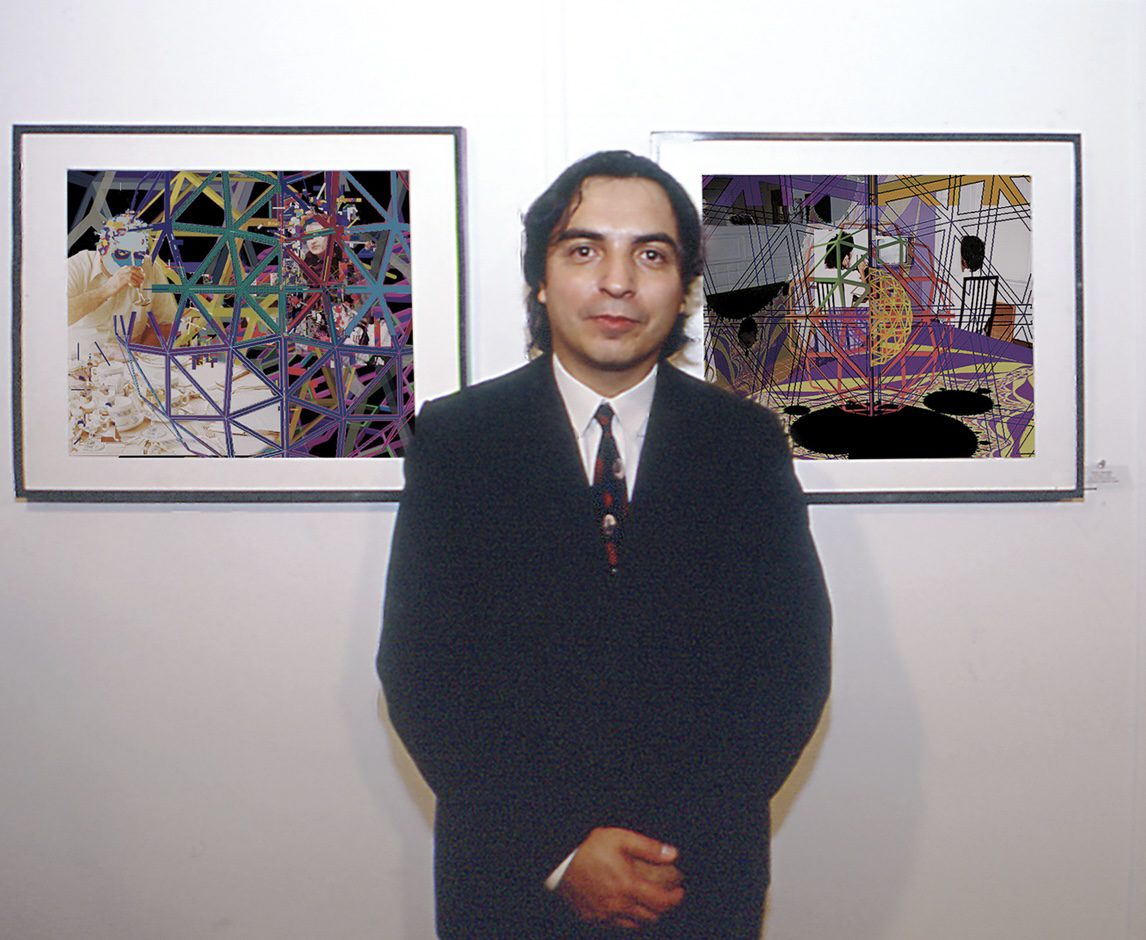
By 1985, he was working on Cubicomp, an early but powerful computer-based 3D modeling and animation system. It all started with learning a basic set of tools for creating a digital image. For this, he used different approaches. One of them was the viewing of graphic objects, which he displayed in analog media and reproduced in digital space. The image entitled Ectoplasmic Kitchen is an example of such work. The original painting was created in 1984. Its digitalization happened in 1987.
Acevedo’s images are composed on an IBM-AT computer using 3D modeling software and output to transparency for exhibition. A computer for an artist is a kind of hybrid of painting and sculpture.
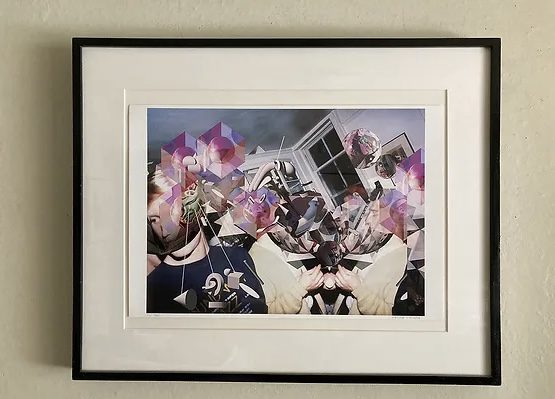
Victor Acevedo’s study of the geometry of synergy influenced his use of polyhedral and spherical-planar arrays in his work. This includes the discovery of the icosahedral structure of the virus shell and the study of fullerene, as well as the study of periodic and non-periodic matrices filling all space. Acevedo is interested in the implications of how micro- and macrocosmic structuring principles might operate or be reflected in human perception. Each image is a scene from everyday life with a subjective and emotional aura. A hemispherical housing is introduced into each image, which alters the perception and depth cues of the viewers. By studying synergistic geometry and the use of computers, Acevedo contributed to the exploration of the unexplored graphic language in the visual arts.
Visual music
In 2011, while in LA, Victor began visiting club nights with underground electronic dance music. Usually, musicians there played drums or performed instrumental hip-hop. This feeling allowed him to see the need and opening for visual effects. For three long years, he was a frequent guest at club nights and watched various bands. British digital artist William Latham was a role model for him. At the very beginning of his observations, Victor joined Los Angeles Video Artists and began attending their meetings. In this community, he learned more about live videos and their creation using programs that can run on a MacBook Pro.
The artist introduced the term electronic visual music in 2013. It was a play on EDM (Electronic Dance Music) and an update of an established genre. It emerged from analog media practice (based on film), while modern options are primarily digital or electronic. The term was waiting for the official presentation. Victor publicly used this term for a live video projection performance at the LA Center for Digital Arts in May 2019.
His vision prompted visual music classics to revive the idea of creating short abstract computer graphic animations. The artist also began to monitor the development of visual effects projected in real time. Mostly, performers use them to enhance live music events.
Acevedo in Context
In addition to visual art, Victor was fond of literature. Thus, he decided to share his knowledge. Victor started writing his book in 2017. However, he repeatedly mentioned in interviews that he had been doing this for about 20 years. All this time he was thinking about the concept of the book.
In the book, he describes the development of works of art and addresses the environment from which his work arose. The story of the book is complemented by essays by four authors, namely Charlotte Frost, Peter Frank, Thomas Miller and Michael J. Masucci. They are presented in addition to the author’s personal notes. The text is supplemented by transcriptions from previously unpublished works and interviews with art historian Patric Prince and scholar Arthur L. Loeb.
The first half is an annotated portfolio, tracing the artist’s path from the first works and early attempts to active work in a digital practice. The second half is an illustrated chronology, highlighting important events related to art.