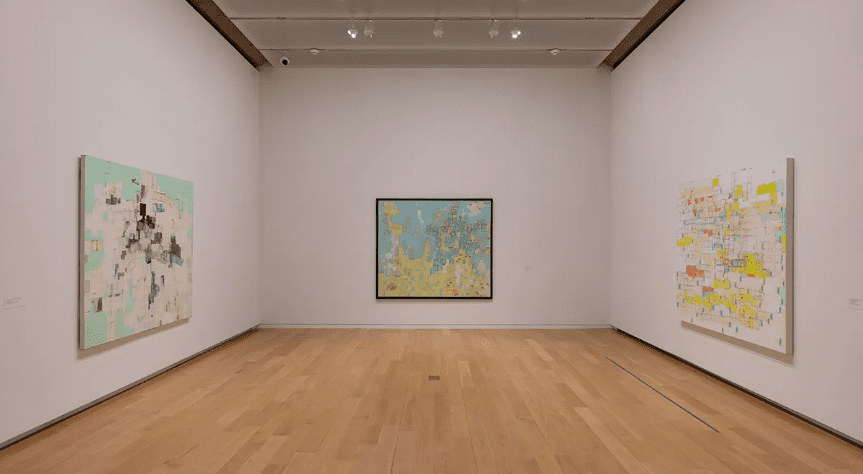

Many city residents are familiar with the work of Mark Bradford, a visual artist who masterfully weaves social and political issues into his abstract art. His creations are displayed in galleries all over the world, but he still finds time to mentor young artists. Find out more about the talented artist’s journey to success and his contributions to the art community on los-angeles.pro.
Growing Up in Los Angeles
Mark Bradford was born and raised in South Los Angeles, a place also known as South Central L.A. His mother ran a hair salon in Leimert Park. When he was 11, the family moved to Santa Monica, but his mother kept her business in the same location.
After high school, Bradford got his cosmetology license and started working at his mother’s salon, which served the local African American community. The services ranged from using hot irons and doing perms to relaxers and hair straightening. He worked as a salon operator while his mother was the owner and a stylist. He recalled the salon as a kind of therapeutic space where women felt safe. During this period, Bradford wasn’t just working at the salon; he was also traveling and going to nightclubs, but he didn’t have any relationships.
He later enrolled at Santa Monica College before transferring to the California Institute of the Arts. He finished his studies in 1991 when he was 30 years old. In 1995, Bradford earned a Bachelor of Fine Arts degree, followed by a Master of Fine Arts degree in 1997.
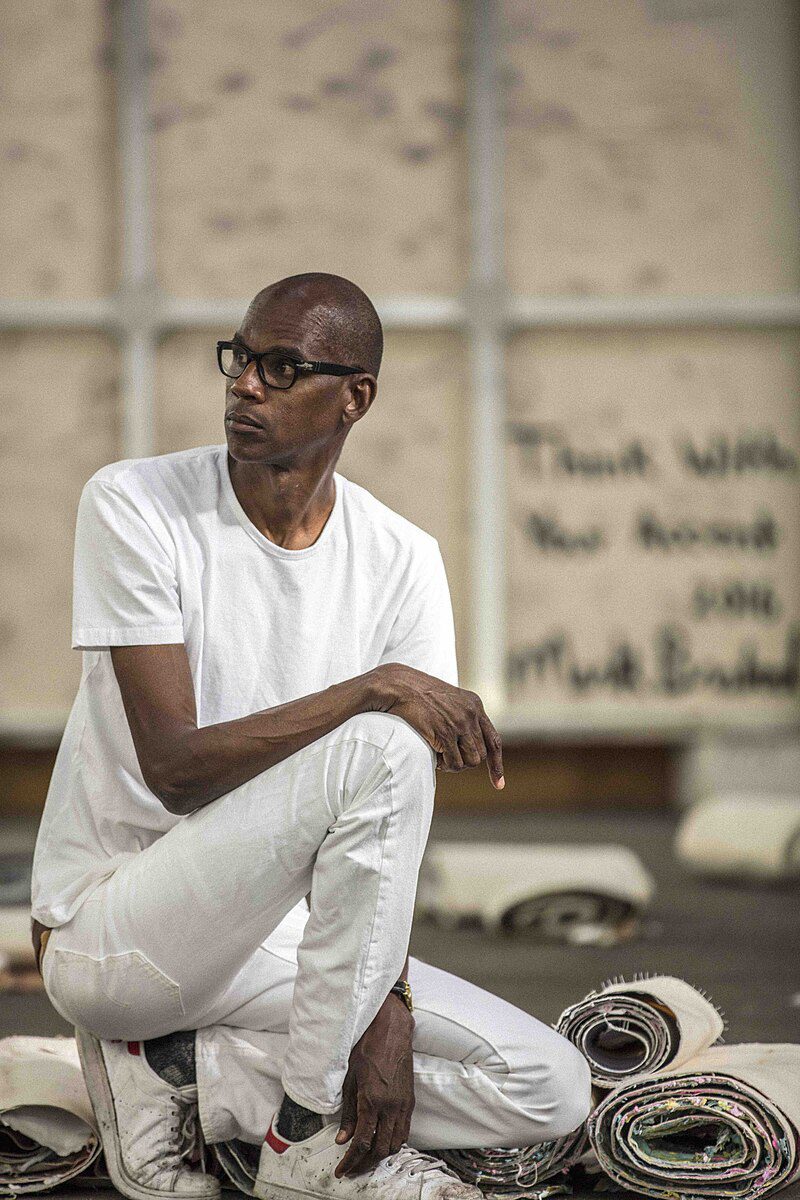
Mark Bradford’s Career
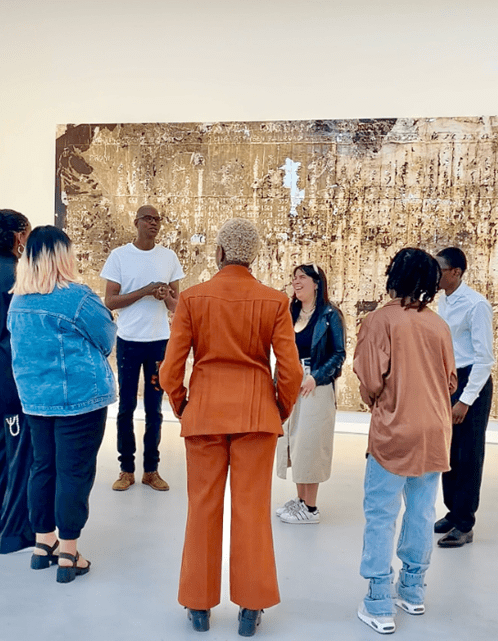
The visual artist is well-known for his abstract, grid-like paintings that blend collage and paint. He creates his pieces by layering paper and cord, which he then carves and manipulates using various tools and techniques like scraping, shredding, gluing, and sanding.
Throughout his career, Bradford has collected and repurposed countless posters—printed sheets advertising local services—that he found plastered around different neighborhoods.
Bradford is acclaimed for his abstract paintings and performance art, with some of his work exploring themes of masculinity and gender.
Notable Works
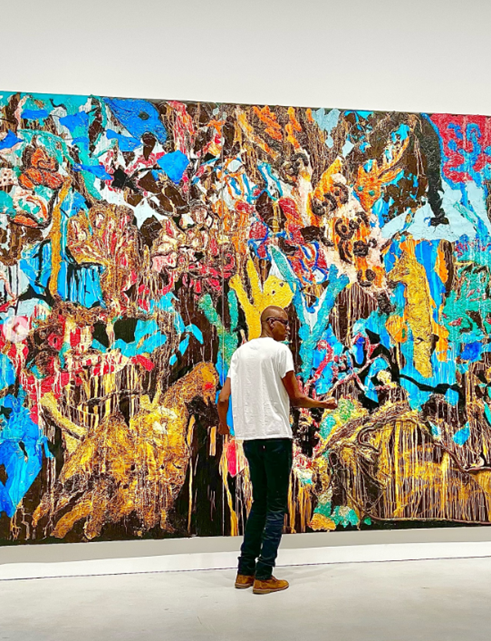
- In 2006, Mark Bradford created two famous installations: “Burned Earth” and “Black Wall Street.” These works were based on the two-day racist massacre in Tulsa in 1921. He revisited the topic in 2021, marking the centennial of the tragic event with the painting “Tulsa Gottdamn.”
- In 2007, Bradford placed a collage titled “Orbit” in the middle of a dense grid of Los Angeles streets. He created this piece using a collage and décollage technique, layered with paint. “Orbit” presents a bird’s-eye view of the city and features iconography of African American sports heroes reminiscent of Basquiat.
- Bradford created a sculpture in 2008 called “A Really Rich Man Is One Whose Children Run into His Arms Even When His Hands Are Empty.” The piece stood 9 feet tall and 9 feet wide.
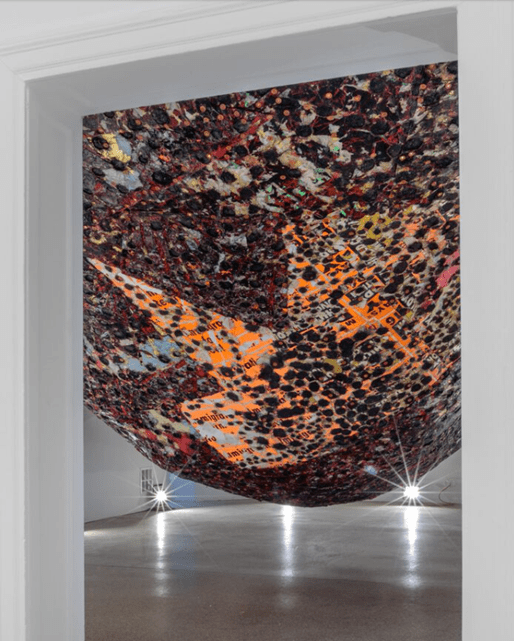
- Also in 2008, Bradford created the installation “Mithra,” an incredible ark measuring 70x20x25 feet, which he built from repurposed plywood. This installation was sent to New Orleans for the Prospect New Orleans contemporary art exhibition. “Mithra” is a tribute to the memory of Hurricane Katrina, a historically powerful and destructive tropical cyclone in August 1952 that caused 1,392 fatalities and immense damage. The memory of Hurricane Katrina also inspired him to create another installation, which was displayed on the rooftop of the Steve Turner Contemporary Art Gallery, across from the Los Angeles County Museum of Art.
- “Belltower” from 2014 is a massive four-sided piece for the Tom Bradley International Terminal at Los Angeles International Airport. This impressive work, made of wood and covered in colored printed paper, resembles wooden siding covered in posters—the same kind that have inspired the artist throughout his career.
- In 2015, Mark Bradford created a paper installation titled “Pull Painting 1,” inspired by the American artist Sol LeWitt. The artwork was displayed along a 60-foot wall at the Wadsworth Atheneum Museum of Art in Hartford.
- The year 2015 was a productive one for Bradford, as he also created “Waterfall” for his solo exhibition “Be Strong, Boquan” in New York.
- Bradford also opened the Elgin Gardens in 2015, which he created specifically for the 1221 Avenue of the Americas building at Rockefeller Center in New York.
- In 2017, the artist created a paper installation called “150 Portrait Tones” at the Los Angeles County Museum of Art (LACMA). According to the LACMA website, the title refers to the name and color code of the pink acrylic Bradford used throughout the painting. The name “Portrait Tone” carries a deeper meaning, serving as a sobering commentary on power and representation.
- The Smithsonian’s Hirshhorn Museum and Sculpture Garden in Washington D.C. commissioned a monumental cyclorama of paintings titled “Pickett’s Charge,” which depicts the climactic assault of the Battle of Gettysburg in 1863 during the American Civil War. This installation spanned 400 linear feet of wall, making it one of Bradford’s largest works. In 2018, the artist unveiled an even larger piece, the 195-foot-tall “What God Hath Wrought,” which became the tallest structure on the University of California, San Diego campus. This monumental commission was based on the powerful impact of technology on communication.
Personal Challenges and Trauma
According to Bradford, he was persecuted starting at age 17. As an African American and a gay man, he says that was enough to attract hatred. Then came the AIDS epidemic. His family and their friends went to an African American church, and many of the men he knew—about 75%—were dying. Before he was even 21, a doctor gave him some good news and some bad news. The good news was that he didn’t have AIDS; the bad news was that he “definitely would.” The doctor told him he needed to “get his house in order.”
At the beginning of the pandemic, the artist was triggered by many things, as it reminded him of the AIDS epidemic. He learned to be resilient and continued his beloved work. His painful memories of the past feed both his art and his social activism.
For example, Bradford is known for his work with foster children in South Los Angeles and Baltimore. He invests the profits from his paintings into projects that support education in the city.
Important Context
While Mark Bradford is an abstract artist, his work consistently explores real-world themes like sexual and racial prejudice, community displacement, and hidden geographies. His journey is an inspiring one, as he started his career in a hair salon and went on to the Venice Biennale in 2017 and was included in Time Magazine’s list of the 100 most influential people of 2021. In 2024, he was awarded the 2023 National Medal of Arts.
According to Mark Bradford, the most important thing for him is that he is an artist.